
Emergency Response:
"After the Disaster: Rebuilding in Haiti, Pakistan, Guatemala and Elsewhere."
GSN Study e-Broad @ CRS
September 16th - 27th 2013
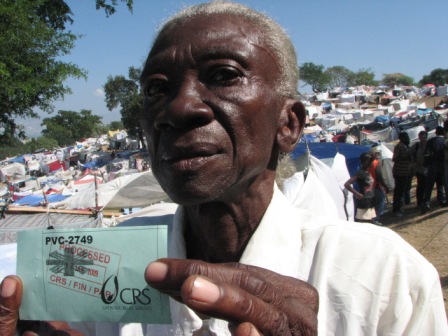
Port-au-Prince, Haiti
Celestin Estana, 70, receives a food voucher from CRS. Following a 7.0 magnitude earthquake that shook Haiti on January 12, 2010, Celestina and her four children are living at the Petionville golf course, where some 50,000 Haitians gather during the day. At night, the camp swells to close to 100,000 people. The US military has a temporary base at the golf course. Families can redeem the food vouchers for bulgar, vegetable oil, and lentils that should last them about two weeks.
Photo by Lane Hartill/Catholic Relief Services
This session will look at how an NGO like CRS responds to a disaster, meeting immediate needs within a framework for longer-term development. The main case study will focus on Haiti -- whose January 2010 earthquake has been called one of the worst humanitarian disasters of modern times -- but reference material will be provided as well on other natural disaster-prone countries, particularly Pakistan, Guatemala, and India.
Readings will consider how CRS and the international community responded in the aftermath of the earthquake in Haiti and what life is like for Haitians now. Finally, the session will explore the best ways to help countries like Haiti, Pakistan, Guatemala, and India prepare for future disasters. CRS experts will share CRS’s innovations in disaster preparation and community empowerment. And students will be encouraged to step back and ask how international disaster aid can be concerned with long-term justice.
Ways to Participate:
STUDY - Read the essay(s)/watch the video(s) that your professor assigns.
BLOG - Post your reflections and respond to student posts on our GSN Blog.
INTERACT w/ CRS - Email your questions to a CRS expert
Review the resources assigned by your professor.
CRS Framing Documents
By Seiko Hirani. This is a very accessible handbook (34 pages, including vibrant photos, graphs, and succinct sections of text) that captures CRS’s experience in creating urban transitional shelters in post-earthquake Haiti. The handbook is meant to show challenges and successes in CRS’s response effort, with an eye toward lessons learned for future disasters.
2.) Video "Haiti Quake Response Year 2" (9 minutes, 19 seconds)
Video retrospective on CRS’s emergency response work in Haiti produced two years post-quake.
3.) Essay "Toward a Spirituality of Accompaniment in Solidarity Partnerships" by Kim Lamberty, Senior Advisor CRS Haiti Partnership Unit. From Missiology: An International Review, Vol XL, no. 2 April 2012. Lamberty is a theologian and senior CRS staff member with deep experience in Haiti. This article reflects on the “growing movement of solidarity” between US donors and Haitians and encourages reflection on what it means to be a donor (or to do service abroad) in a way that is helpful to the recipient and builds mutual relationships.
1.) "Beyond Physical Structures - Integrating Protection" - this two page brochure outlines main principles, challenges, and case examples related to keeping people safe in emergency response settings.
2.) "Building Equitable Transitional Shelters in Guatemala" - this two-page essay describes a multi-sector, community-based effort to build transitional shelters after 2010 Tropical Storm Agatha.
3.) "Using Vouchers for Emergency Relief Guatemala" - This two-page essay discusses the community empowerment and economic benefits gained in using vouchers for buying relief supplies post-flood (instead of traditional aid) in wake of 2010 Tropical Storm Agatha.
4.) "Flood Resistant Pilot Shelter Project in India" - Two-page brochure illustrating disasater risk reduction work in flood-prone region in eastern India.
Faculty Recommended Supporting Resources:
1.) "Frontline: The Quake" A powerful report on Haiti’s 2010 tragedy, with footage of the moments after the quake and context on doing aid work in Haiti. Produced shortly after the earthquake, the video asks what can be done now -- and who will do it?
2.) "To Heal Haiti Look to History, Not Nature" - January 21st, 2010 op-ed in the New York Times by Mark Danner. Danner pointedly discusses Haiti’s history and the country’s complex historical relationship with the US as a frame for policy recommendations for reconstruction.
Coming soon.
- Sign up to become a GSN Member
- Select the "session.
- Post your reflection and response to other student postings.
- Be sure to sign your name and class so your professor can identify your work.
- Email your question to campus@crs.org
- Join a Live Webcast
- Watch a Recorded Webcast
- Email campus@crs.org.


